 English
 German
English
German
German
English
German
The 2023 zeb Great Women network meeting was dedicated to the “E” in ESG and the role of financial services providers in the green transformation. Three experts from different economic sectors provided insights into the economic challenges and opportunities associated with climate change. They gave our network members a well-structured and at the same time concrete perspective on the role of financial services providers as the drive belt of the green transformation.
ECB Director General Cornelia Holthausen explained how the central bank monitors climate risks for the financial system and takes them into account in its monetary policy.
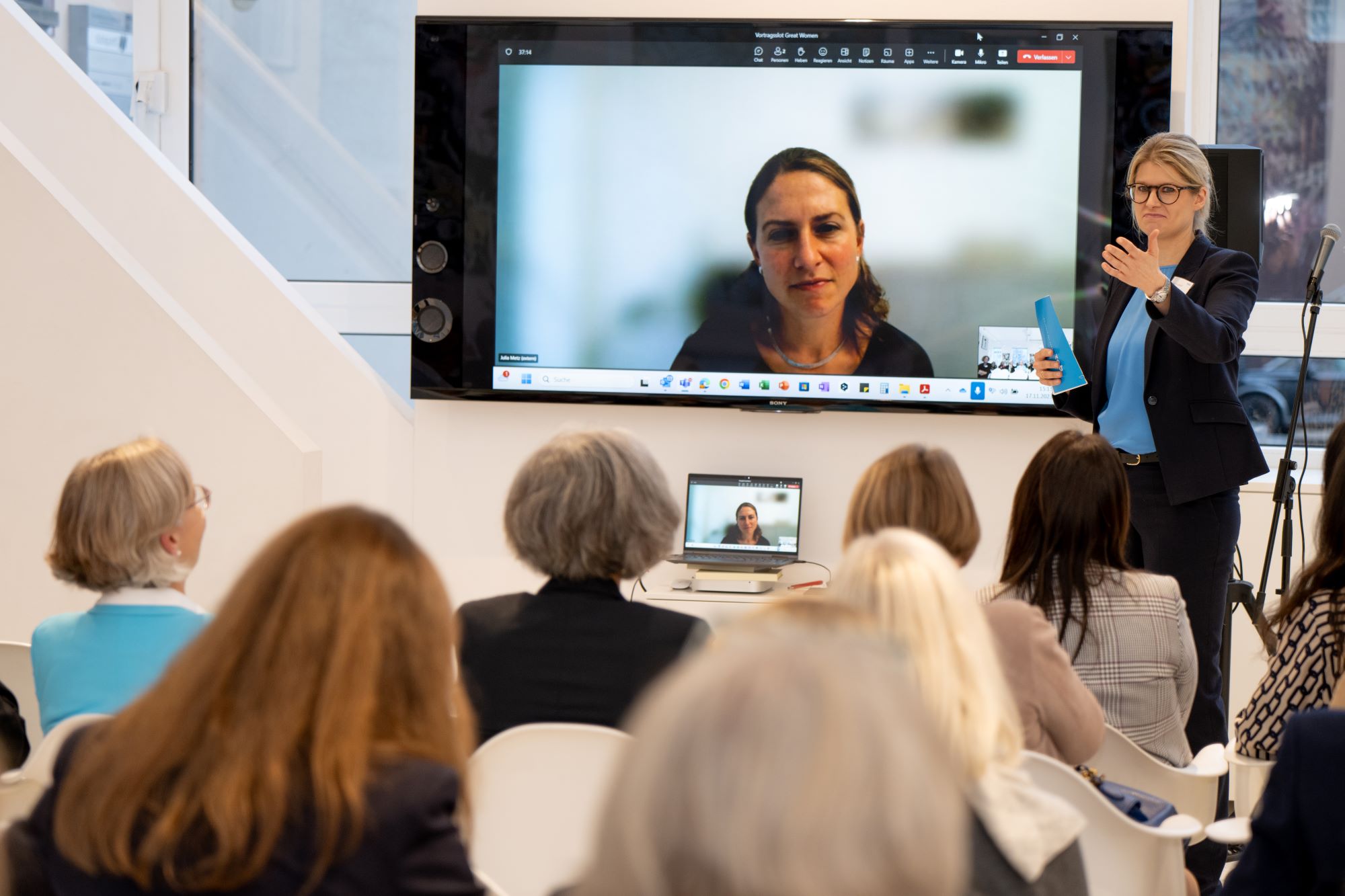
Julia Metz from Agora Energiewende argued in favor of electrification as the most effective measure for reducing carbon emissions. Astrid Wuttke from the architectural practice schneider+schumacher showed how the “Building Transformation” concept can make the construction industry more sustainable and reduce carbon emissions.
All participating Great Women agreed that banks and other financial institutions play a key role in greening the economy and bear responsibility as well as risks and opportunities.

Dr. Holthausen (ECB) made no secret of this: according to her, financial institutions as investors, insurers and players on the new, “green” capital markets, are playing a key role in greening the economy. That’s why the ECB had set itself the goal of identifying, assessing and managing climate risks for the financial system.
Further information on the ECB’s sustainability-related activities can be found here (German only).
Energy transition expert Dr. Metz highlighted the challenges and opportunities in three different investment areas – electrification, circular economy and carbon cycle – which allow the industrial sector to contribute to a quick decarbonization. However, she also made it clear that the necessary political conditions to support the industry in its transformation and put it on course for climate neutrality were still insufficient in many areas.
Further information on Agora Energiewende’s sustainability-related activities can be found here (German only).
Astrid Wuttke, partner at the Frankfurt architectural practice schneider+schumacher , presented new approaches in the construction industry, making the possible climate protection effects of strategic changes very concrete and comprehensible.
She argued that the so-called “Building Transformation” – in the sense of focusing on refurbishment – offered considerable potential in that regard – for one thing, because the “gray energy” contained in existing buildings remained tied up in a targeted manner and, for another, because effective reductions in carbon emissions could be achieved even with simple and therefore cost-effective refurbishment measures.
Further information on schneider+schumacher’s sustainability-related activities can be found here (German only).