Savings banks – strategy 2026
The financial industry is undergoing a profound transformation. Savings banks are faced with the central question: how do we remain robust and relevant for customers in the long term?
 English
 German

The financial industry is undergoing a profound transformation. Savings banks are faced with the central question: how do we remain robust and relevant for customers in the long term?
Charles Darwin recognized a basic truth early on: “It is not the strongest of the species that survives, […]. It is the one most adaptable to change.”
However, adaptability requires knowing what you need to adapt to. This is the core of every strategic consideration. Strategy is not about just doing something or being busy – it is about doing the right things to achieve a previously defined goal. Without a clear goal, every effort becomes arbitrary, and every resource is potentially wasted.
This is why the development of target pictures is so essential for savings banks in order to remain resilient and relevant for their customers in the long term.

The significant rise in interest rates on the money and capital markets has eased the situation in recent years thanks to a return in deposit margins – net interest spreads on the liabilities side have risen, but at the same time transformation results have fallen.
New market players such as Trade Republic and Revolut are intensifying competitive pressure. Today’s customers expect “fast, convenient and simple” services – traditional loyalty to one particular bank is waning while price sensitivity is on the rise. Savings banks must systematically adapt to this change in expectations.
The persistently sluggish economy in Germany and high geopolitical uncertainty are making new lending business with reliable counterparties more difficult. Limited capital resources are further exacerbating the situation. Securing existing and developing new profitable business areas are becoming crucial success factors.
Legal requirements must be implemented efficiently along the business model, and the necessary resources and expertise must be expanded to actively exploit opportunities in supporting savings bank customers during the transformation.
Significant investment requirements weigh on operating results: physical and digital infrastructure, energy-efficient refurbishment of properties, recruitment and training of specialists and executives. Increased regulatory requirements (Basel IV, 9th MaRisk amendment) must be stringently implemented.
The speed of development of automation and AI requires the reinforcement of resources and expertise. Savings banks must ensure their capability to integrate association solutions in order to strengthen self-service and achieve efficiency gains.
Demographic change and changing generational expectations pose fundamental challenges for HR work. Strategic HR planning is turning into a critical success factor for the business model.
In light of limited resources, savings banks have to set strategic priorities.
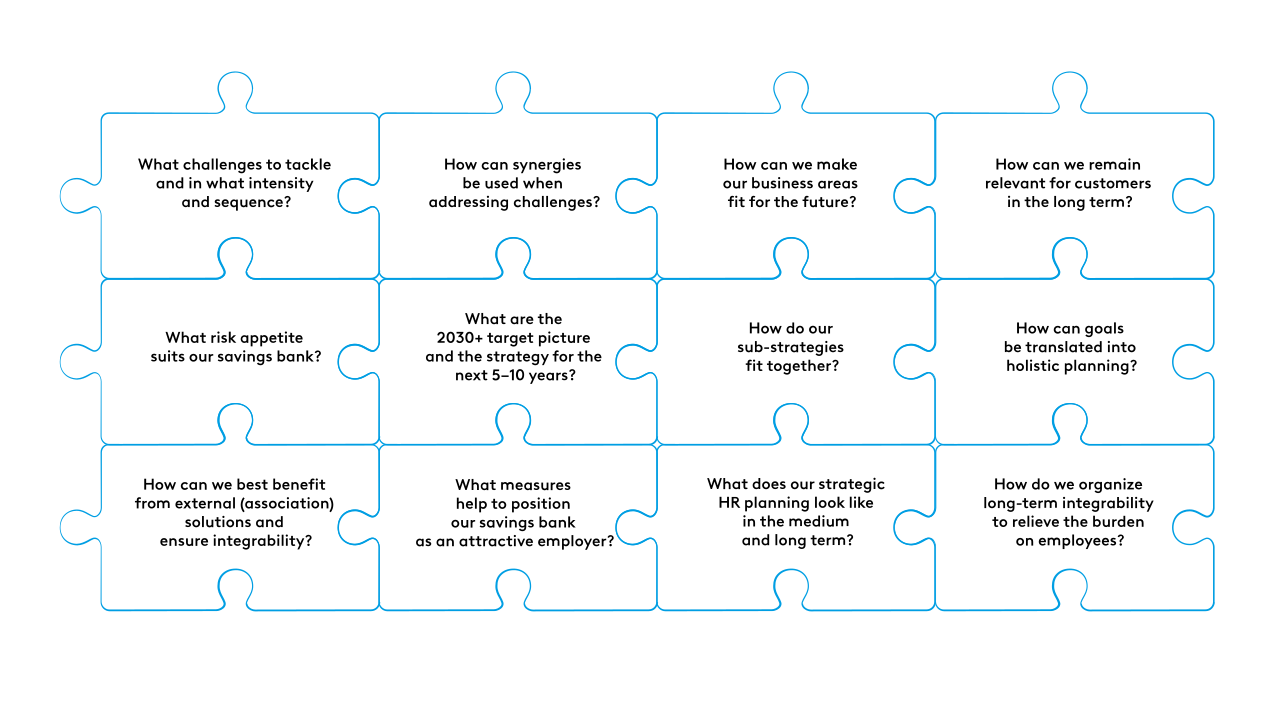
The strategies of the savings banks and their association partners must provide the appropriate answers for each specific case, continually involve executives and employees and create a reliable basis for further operationalization.
Ongoing developments in the savings bank environment must be taken into account, and there must be sufficient scope for adjustments within the annual strategy and planning process.

First of all, well-founded transparency regarding strengths and weaknesses as well as opportunities and risks of the savings bank and association partners must be established. In addition to the analysis of figures, data and facts as well as the comparison and benchmarking of these, a qualitative survey and assessment (e.g. via semi-structured or in-depth interviews) are of great importance in order to obtain a complete overview and create a common starting point.
Based on the specific initial situation and in collaboration with bank staff, we derive the strategic target picture of the savings bank – taking into account current trends and developments, general economic conditions and association standards as well as the zeb target picture model for the sound assessment of concrete income and efficiency potential. State-of-the-art methods such as eigenland® and Design Thinking are used in this process. The degrees of participation of executives and employees in the strategy process are determined based on the savings bank’s specific culture.
The operationalization of the strategic target picture and the business strategy is essential to gain clarity about the issues and fields of action to be addressed and to actively involve executives and employees in bringing strategic concepts to life.
Based on the defined overarching business strategy or sub-strategies, further strategy work can aim at individual topics such as personnel or costs, depending on the breadth and depth of the required or necessary solution. It can also include the creation of a road map with fields of action for implementing and achieving the strategic target picture or a longer-term transformation program.
A successful strategy needs suitable key figures and metrics to allow for monitoring the desired goals or the path towards them. Key figures should provide a valid representation of both the savings bank’s and its customers’ perspectives. A lean reporting system must be implemented to continuously monitor the implementation of the strategy and make progress and successes visible.
zeb’s experienced consultants support savings banks, associations and network partners in all steps of the strategy work – from ideation to practical implementation.
Feel free to contact us for a no-obligation discussion about your strategic orientation and the target picture of your savings bank.
Sparkasse Hellweg-Lippe
KSK Düsseldorf
Sparkasse Lemgo
Kasseler Sparkasse
KSK Weilburg
Frankfurter Sparkasse
Sparkasse Vorpommern
Sparkasse Neuss
Rheinhessen Sparkasse
Sparkasse Ingolstadt Eichstätt
Sparkasse Düren
KSK Heinsberg
Sparkasse Südpfalz
Sparkasse Tauberfranken
LzO
Finanz Informatik
Berliner Sparkasse
Sparkassenverband Westfalen-Lippe
SSK Mönchengladbach
SK Rhein-Haardt
KSK Stade